A new part used to mean a new perception problem.
Collect data. Label images. Train a model. Validate it. Tune it. Deploy it. Then do it again when the SKU changes.
Zero-shot 6D pose estimation is changing that workflow.
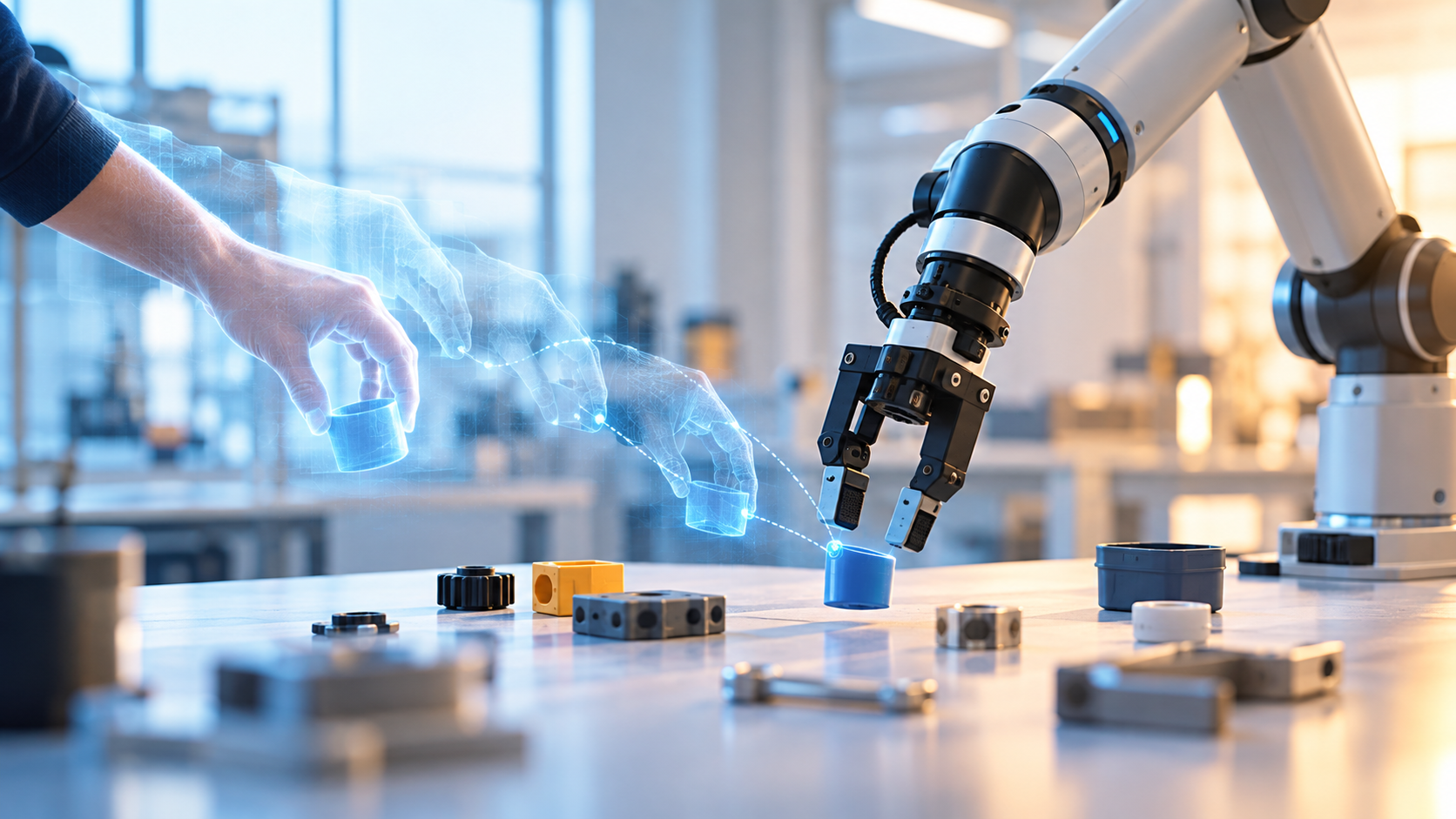
With systems such as NVIDIA’s FoundationPose, the object-specific input can be reduced to a CAD model. Instead of training a new perception model for every part, the system uses a pre-trained model to estimate where an object is and how it is oriented in 3D.
That distinction matters operationally. A new object can move from being a data-collection project to an onboarding problem. A camera change can become a calibration problem rather than a reason to rebuild the training dataset.
But “no training required” needs some unpacking. The training has not disappeared. It has simply been done once, at a much larger scale, and packaged into a model that can generalise to objects it has never seen.
This article looks at what that actually means in practice: how FoundationPose works, what the benchmark results do and do not prove, where the deployment bottlenecks are, and when zero-shot pose estimation is the wrong tool altogether.
§ 01 The real problem: the re-teach tax
A common approach to robotic manipulation is to train a visuomotor policy from demonstrations. A human teleoperates the robot through a task. The system records camera streams and joint trajectories. The resulting data is then used to train a policy that maps observations to actions.
For a robust manipulation task, that can mean hundreds of demonstrations.
The problem is not that this approach does not work. It does.
The problem is what happens when the environment changes. Move a camera. Change the lighting. Introduce a new object variant. Reconfigure the work cell. Depending on how tightly the policy is coupled to the observations it was trained on, those changes can create a new data problem. The system learned from the environment it was shown.
Zero-shot pose estimation takes a narrower approach. Instead of learning:
Pixels → Robot actions
it solves:
RGB-D image + 3D object model → Object pose
The output is a 6D pose: the position and orientation of the object relative to the camera. Everything downstream — grasp planning, motion planning, approach trajectories, insertion — can operate from that geometric representation.
That is the important shift. The value is not simply that the system is “more accurate.”
The value is that a change in the work cell no longer necessarily creates a new machine-learning project.
§ 02 What FoundationPose is actually doing
FoundationPose is best understood as a learned scoring function wrapped around a renderer. It does not simply look at an image and directly predict the pose of every possible object. Instead, given an object model and an observation, it generates candidate poses, renders the object under those poses, and uses learned networks to determine which candidates best explain what the camera sees.
The workflow has three distinct stages.
Phase A — Onboarding
For the model-based workflow, the object-specific input is a textured 3D mesh. There is no gradient descent. No object-specific dataset. No checkpoint trained for that individual part.
The mesh defines the object’s coordinate frame, which means downstream information can also be defined relative to that frame:
- grasp points
- approach vectors
- insertion axes
- manipulation constraints
Once defined in the object’s coordinate system, those relationships remain useful even if the camera or cell configuration changes. FoundationPose also supports a model-free path using reference RGB-D views to build an object representation that can be rendered downstream.
But in both cases, the important point is the same:
The deployed model does not need to be retrained for each object.
Phase B — Registration
Registration is the computationally expensive step. Given a detection or crop of the object, FoundationPose generates a set of candidate poses. Translation is initialised using depth information. Rotation is explored through multiple viewpoints and in-plane rotations, creating a batch of hypotheses.
Each hypothesis is rendered. The system then compares those renders against the observed object and iteratively refines the candidates. The refine network predicts translation and rotation updates. A scoring network then ranks the resulting hypotheses. The best explanation of the observed object becomes the pose estimate.
This is why registration is relatively expensive:
The system may need to render and evaluate hundreds of candidate poses.
Phase C — Tracking
Once the object has been registered, the next frame is much cheaper. The previous pose becomes the starting hypothesis. Instead of evaluating hundreds of possibilities, the system only needs to refine the existing estimate.
This registration-versus-tracking asymmetry is one of the most important deployment details. It also explains why looking only at registration throughput can be misleading. A robot does not necessarily need to perform a full registration for every frame.
The honest meaning of “no training required”
“No training required” is true from the perspective of the deployment team. It is not true in aggregate.
FoundationPose was trained using hundreds of thousands of synthetic images, augmented into a multi-million-image training set and generated across tens of thousands of object models.
The training cost was not eliminated. It was paid once, at vendor scale, and amortised across deployments. That is what makes the model reusable.
§ 03 Why the CAD model matters
It is tempting to think of the CAD model as simply a visual template. It is more useful than that. The CAD model defines the coordinate system the robot can reason about.
The pose estimator tells the system:
Where is this coordinate system relative to the camera?
That creates a chain from perception to manipulation. A grasp can be authored in the object frame. An insertion axis can be defined in the object frame. An approach vector can be defined in the object frame. The perception system only needs to recover where that object is in the current scene.
That separation is powerful. The robot’s manipulation logic does not need to be rewritten every time the camera moves. The calibration relationship changes, but the object geometry remains the same.
There are practical details that matter here.
Units and scale are not cosmetic
A mesh exported in millimetres when the pipeline expects metres can produce a pose that is wrong by a factor of 1,000.
Mesh complexity affects performance
Registration requires rendering the mesh repeatedly. A CAD export containing millions of triangles may work, but it increases rendering cost. Mesh preparation is therefore part of deployment.
§ 04 What the benchmarks actually show
The BOP benchmark is one of the major references for evaluating 6D object pose estimation. Its headline metric, AR, averages recall across multiple pose-error functions and correctness thresholds.
The more important distinction, however, is the task. Traditional pose estimation benchmarks focused on seen objects — models were allowed to train on the objects they would later be evaluated on. The unseen-object setting asks a different question:
Can the system estimate the pose of an object it was not specifically trained on, given only its CAD model?
That is the category in which FoundationPose competes.
| Method | Task | Input | Per-object training? | AR (Core) | Reported time / image |
|---|---|---|---|---|---|
| CosyPose (2020) | Seen objects | RGB + optional depth ICP | Yes | 0.698 | ~8 s with ICP |
| GDRNPP (2022) | Seen objects | RGB-D | Yes | 0.837 | 0.23 s (fastest variant) |
| MegaPose | Unseen objects | RGB | No | 0.549 | ~47 s |
| MegaPose + Teaser++ | Unseen objects | RGB-D | No | 0.628 | — |
| SAM-6D | Unseen objects | RGB-D | No | 0.683 | — |
| GenFlow-MultiHypo16 | Unseen objects | RGB-D | No | 0.674 | ~21 s |
| FoundationPose | Unseen objects | RGB-D | No | 0.726 | Hardware dependent |
| Co-op | Unseen objects | RGB-D | No | ≈0.76 | 0.8 s |
| FreeZeV2.1 | Unseen objects | RGB-D | No | 0.821 | 24.9 s |
Cross-method comparisons should be treated as indicative rather than exact. Detector choice, hardware, evaluation configuration and reported timing methodology vary.
The interesting story is not which row wins. It is the trajectory. Earlier systems achieved strong performance by training specifically on the objects they would encounter. Within a few years, unseen-object methods approached — and in some cases exceeded — performance levels that previously required object-specific training.
FoundationPose is not the most accurate method in the table. Its value is its position on the accuracy-versus-deployment tradeoff. It combines competitive unseen-object performance with a supported NVIDIA deployment stack, TensorRT optimisation, ROS 2 integration and a dedicated tracking path.
For a robotic work cell, the best benchmark score is not automatically the best system. A method that takes 25 seconds to process an image may be academically impressive and operationally unusable for a particular application.
The average hides the difficult cases
FoundationPose’s performance varies significantly across datasets.
| Dataset | LM-O | T-LESS | TUD-L | IC-BIN | ITODD | HB | YCB-V |
|---|---|---|---|---|---|---|---|
| FoundationPose AR | 0.733 | 0.617 | 0.906 | 0.528 | 0.609 | 0.809 | 0.882 |
The average is useful. The spread is more useful. TUD-L, containing relatively favourable cases, reaches 0.906. IC-BIN, with dense clutter and heavy occlusion, reaches 0.528.
Do not plan around the headline benchmark average. Plan around the conditions that resemble your application.
§ 05 Where deployment plans usually go wrong
The first mistake is looking at registration throughput and assuming that number represents the full runtime behaviour of the system.
NVIDIA’s Isaac ROS benchmarks for the FoundationPose pose estimation node at 720p show:
| Platform | Registration throughput | Latency | Deployment class |
|---|---|---|---|
| x86_64 + RTX 5090 | 5.76 fps | 170 ms | Workstation / edge server |
| x86_64 + RTX 5070 | 3.11 fps | 340 ms | Cost-effective cell PC |
| Jetson AGX Thor T5000 | 2.21 fps | 460 ms | On-robot |
| Jetson AGX Thor T4000 | 1.59 fps | 760 ms | On-robot |
| DGX Spark | 1.64 fps | 690 ms | Development system |
| Jetson AGX Orin | 0.50 fps | 3,800 ms | Previous-generation edge |
At first glance, 0.50 fps on an AGX Orin looks disqualifying. But registration is not the only path. The intended deployment model is:
Register → Track → Re-register when required
NVIDIA’s profiling of the refine network shows a substantial difference between the estimation and tracking paths on the same hardware. The end-to-end system will not achieve the raw network benchmark in practice, but the asymmetry matters.
For deployment planning, the correct question is not:
“How many registrations per second can this GPU run?”
It is:
“How often does this application need to register, and how long can it reliably track before re-registration?”
That is a much more useful engineering question.
§ 06 Where zero-shot stops being magic
Zero-shot pose estimation removes an important deployment burden. It does not remove the rest of robotics.
1 — Detection can become the bottleneck
Pose estimation still needs to know where to look. If the detector or segmenter misses the object, the pose estimator has nothing to estimate. BOP analysis identifies detection as a major bottleneck for unseen-object pipelines. For a fixed industrial cell, this may be manageable through a dedicated detector or segmentation strategy — but that component is still part of the system. Zero-shot pose estimation does not make object detection free.
2 — Depth quality sets a hard limit
FoundationPose relies on RGB-D sensing. Reflective, transparent and difficult surfaces can degrade or eliminate the depth information the pipeline depends on. Polished metal, clear plastic and certain dark surfaces can therefore become sensing problems rather than modelling problems. Changing the pose estimator does not recover depth that the sensor never measured.
Sometimes the right answer is:
- a different sensor
- improved lighting
- another sensing modality
- learned stereo
- changes to the physical setup
The model is not always the bottleneck.
3 — Symmetry still needs to be handled
A cylindrical object can have multiple physically equivalent orientations. If the application requires the system to understand that those orientations are equivalent, symmetry must be configured correctly. Otherwise, the robot may receive pose estimates that are mathematically different but physically identical — which can create instability downstream.
4 — Calibration does not disappear
The pose estimator produces an object’s pose relative to the camera. The robot operates relative to its own base frame. The transformation between those coordinate systems still needs to be calibrated. Move the camera, and you may no longer need to retrain the perception model — but you still need to update calibration.
Zero-shot removes one category of engineering work. It does not remove the entire integration problem.
5 — A pose is not a policy
Pose estimation tells the robot where the object is. It does not automatically tell the robot what to do next. Grasp selection, collision avoidance, motion planning, force control and contact-rich manipulation remain separate problems.
This distinction matters because pose estimation is excellent for tasks that can be expressed as:
Find the rigid object → Execute a planned motion relative to it
It is not a universal replacement for learned manipulation policies.
§ 07 When should you use what?
| Situation | Recommended approach | Why |
|---|---|---|
| Rigid parts with CAD models and changing SKUs | Zero-shot pose estimation | A new part can be onboarded without building a new training dataset |
| Cameras move between deployments | Zero-shot + recalibration | The perception model is reusable; calibration still needs updating |
| Small, fixed catalogue and static multi-camera rig | Per-object trained pipeline may be worth evaluating | Object-specific training can still provide advantages in tightly controlled environments |
| Transparent, highly reflective or featureless parts | Fix sensing first | Poor depth cannot be recovered by swapping pose models |
| Deformable objects, cloth, cables or granular material | Learned policy | There is no stable rigid pose to estimate |
| Contact-rich insertion or force-dependent assembly | Hybrid approach | Pose can handle coarse alignment while another controller handles contact |
| Maximum runtime throughput with available training resources | Purpose-built per-object model | A specialised model can be faster than render-and-compare approaches |
There is no universally correct architecture. The mistake is choosing a learning-heavy solution for a problem that is fundamentally geometric — or choosing a geometric solution for a task that genuinely requires learned behaviour.
§ 08 The bigger shift
The most important implication of FoundationPose is not that one model achieved a particular benchmark score. It is that the architecture of robot perception is changing.
For a long time, adding a new object often meant adding a new dataset. A new object created a new training requirement. A changed environment could create a new validation problem. A changed camera could invalidate assumptions baked into the data.
The emerging alternative is different.
The model learns a general capability once. Object-specific information is supplied through geometry. The same perception infrastructure can then be reused across parts and deployments.
That does not mean every robotic problem has become zero-shot. It has not. Detection remains difficult. Sensors still fail. Calibration still matters. Some tasks require learned policies. Others require specialised perception.
But for rigid-object manipulation where a CAD model exists, the unit of change is beginning to shift. A new part no longer has to mean:
Collect data → Train → Validate → Deploy
It can increasingly mean:
Prepare the geometry → Configure the pipeline → Calibrate → Validate
That is not a small technical improvement. It changes what deployment costs. And that is the real value of zero-shot pose estimation.
Working on a robotic system that keeps needing to be re-taught?
The right first question is not “Which AI model should we use?”
We build perception and manipulation pipelines around ROS 2, Isaac ROS and modern robot perception systems — from sensor selection and calibration through to deployment and validation.
It’s: What problem are we actually trying to make the robot solve?
ZERO-SHOT POSE ESTIMATION — TECHNICAL BRIEF