The world doesn't explain itself.
How a personal loss shaped a mission to make machines understand the world around them

Balaji
6 years at Spatia
Author's Perspective
Automation is not new. It started in the Stone Age, when we first picked up tools to make hard work easier. Ever since I became an adult, I've wanted to make this world better not just for me, but for everyone. One memory changed the direction of my work entirely.
A machine that doesn't understand its environment can't reliably help the people working alongside it. That's what we're solving at Spatia.
My maternal uncle lost his leg while working in a factory. A momentary distraction was all it took. The machine couldn't recognize what was happening. I still remember the struggles he went through afterward not just physically, but emotionally. Body shaming. The loss of confidence. The changes it brought to his daily life. That was the day safety stopped being just a word. It became personal. That's how Seewise.AI was born. Not as a product idea. As a cause. A way to make the world a little better.
Over the years, Seewise exposed us to the realities many workers face every day handling life-threatening tasks, repeating the same motions and the same risks day after day, working around toxic chemicals often without knowing the long-term consequences. Many of us are fortunate enough to never see this side of work. We spend our days in offices and high-rise buildings, far removed from factory floors where these risks are real. Some people can't stand near a foundry molding area for even five minutes. For others, it's their everyday environment.
Divide & Conquer
Break large systems into smaller, verifiable problems. Composability is the foundation of reliable physical AI.
Iterate Continuously
Real systems evolve every day. Ship fast, observe reality, refine the model. The loop never ends.
Understand Reality
Build for the real world, not the benchmark. The physical environment is the test suite that matters.
“A machine that doesn't understand its environment can't reliably help the people working alongside it.”
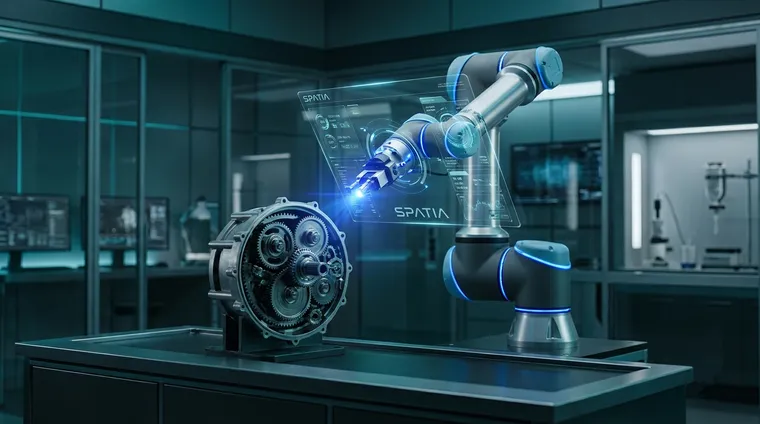
Spatial intelligence deployed in real industrial environments.
Today, everyone is talking about humanoids and robots that look almost human. It's fascinating. But there's something important that often gets overlooked. These robots don't come plug-and-play. The moment they're switched on, they don't know left from right. They don't know the top from bottom. They don't know what's safe and what's dangerous. Whether it's a foundry, a warehouse, or an engine assembly line, they have to learn how to understand the environment around them.
That's spatial understanding. And in many ways, it's the same problem I saw on that factory floor years ago just at a much larger scale. A machine that doesn't understand its environment can't reliably help the people working alongside it. That's what we're solving at Spatia. Machines should understand the environments they operate in. They should improve safety, maintain quality, and increase productivity at scale.
It's a difficult problem. That's exactly why it's worth solving. For everyone still standing on the factory floor today.
Share this article

Balaji
LinkedInCEO · 6 years at Spatia
Balaji is the CEO and co-founder of Spatia. He leads the company's vision for spatial intelligence as the foundational layer of physical AI driven by a belief that machines must understand the world before they can make it safer for the people working in it.
More engineering
perspectives.
Thoughtful essays from the people building intelligent machines. Delivered monthly, no fluff.
No spam. Unsubscribe any time.
Ready to build
Physical AI?
We're looking for engineers, researchers, and builders who want to work on some of the hardest problems in autonomous systems.
Explore Opportunities